
Table of Contents
- The Legal Foundation: Freehold vs. Leasehold Areas
- Can You Buy Property in Dubai Without Residency?
- Is It Safe to Buy Property in Dubai? Legal Protections & Escrow Laws
- How to Invest in Property in Dubai: The Standard Acquisition Process
- How to Invest in Dubai Real Estate with Little Money
- Common Property Acquisition Options: Quick Comparison
- Actionable Rules Before Committing Capital
- In Conclusion: Can Expats Buy Property in Dubai?
- FAQs
If you think that buying a house in the UAE requires a local company sponsor, UAE citizenship, or lot of money in cash on day one, I can understand your skepticism. But as I got into the details of the Dubai Land Department (DLD) regulations and began to research the statutes for real property transactions, the stats tell a very different story.
As per Dubai Law No. 7 of 2006 concerning real property registration and Regulation No. 3 of 2006, the law makes clear that non-citizen residents and non-residents, regardless of their nationality or country of residence, have full legal entitlement to buy, sell, rent, and bequeath property. The Dubai Land Department’s open registry statistics also show that non-resident foreigners and expats represent more than 50% of all sales to residents in the emirate. This confirms that can expats buy property in dubai with 100% outright ownership is no longer a legal question it is standard law.
Knowing the actual is a huge relief, especially if you aim to protect your wealth and protect your money and go through the ways of going to. If so, then you will want a lawyer to direct you on the development of the real estate, the division of zoning, the legal costs, and how you buy, before you make a deposit check.
The Legal Foundation: Freehold vs. Leasehold Areas
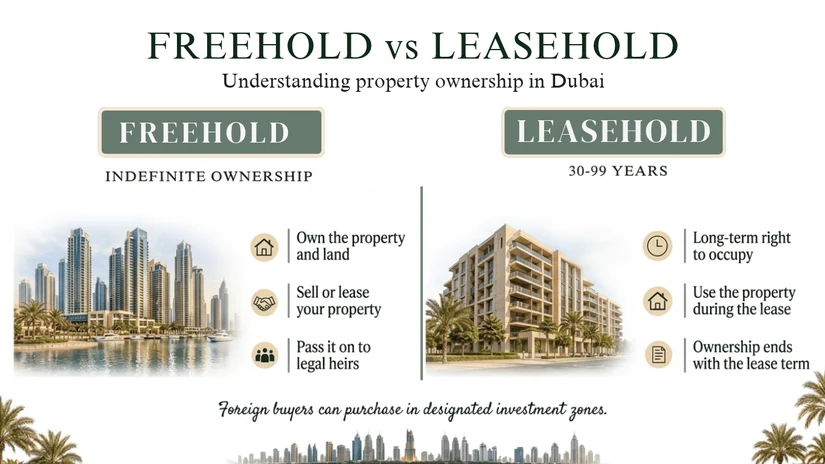
Can expats buy property in Dubai anywhere they like? The most important rule for foreigners buying property in the UAE is: geographic zones. More specifically, UAE residents are free to buy property across the emirate; foreign residents will need to buy only within specified investment zones.
Freehold Zones: Land where the government allows non-GCC nationals to own the unit indefinitely, including the land on which it is built (freehold). You can sell or lease it or leave it to your legal heirs without any time limitation. There are over 65 large areas in Dubai, and they are all under freehold, including the areas of Dubai Marina, Downtown Dubai, Palm Jumeirah, Business Bay, JVC and Dubai Hills Estate.
Leasehold zones: In all areas of non-freehold tenure, foreigners have the ability to take a long-term leasehold known as a ‘turate’ – contracts in the GCC are usually between 30 – 99 years. This gives full use and the right to occupy the property during the lease period only.
When you buy an acquired freehold property to remodel, adapt or develop, you should be aware of architectural balance. Knowing how to choose an interior design style helps you make modifications to match the structure and your lifestyle.
Can You Buy Property in Dubai Without Residency?
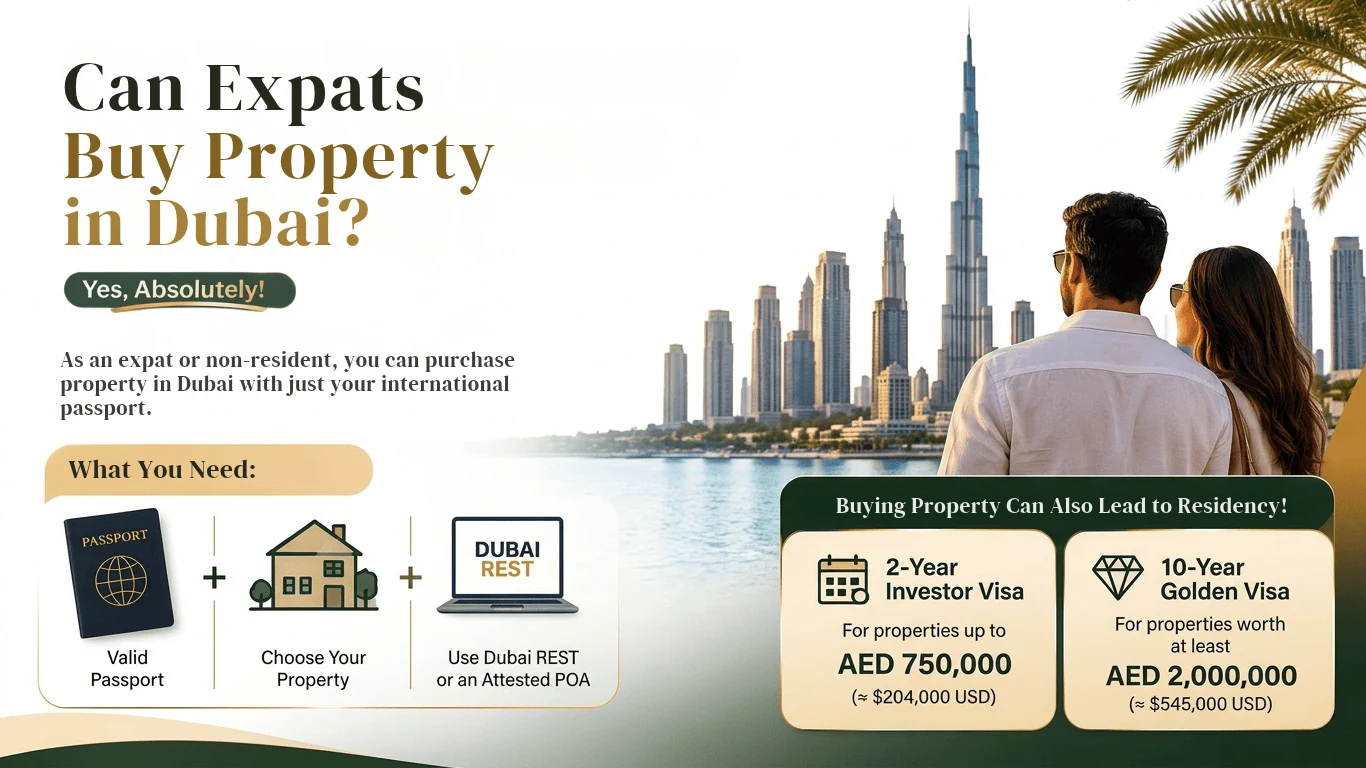
Can expats buy property in Dubai without living here? Another myth that persists is that you need a UAE residence visa and Emirates ID before entering the market.
In short: No. Can you buy property in Dubai without residency? Yes, totally.
You already have your only required ID document as a non-resident: your valid international passport. The transaction can be arranged on your visit to Dubai with a tourist visa, or remotely through an officially attested POA and the Dubai REST digital platform.
However, buying property can actually lead to residency:
2-Year Investor Visa: Valid for property with up to AED 750,000 (approx. $ 204,000 USD) on confirmed residential investments.
10-Year Golden Visa: Available on existing or off-plan properties with an aggregate purchase value of a minimum of AED 2,000,000 (approximately USD 545,000), no limit to the number of years for which the visa is granted.
Is It Safe to Buy Property in Dubai? Legal Protections & Escrow Laws
Can expats buy property in Dubai safely? Before wiring money to overseas properties, a prudent investor considers: Is it safe to buy property in Dubai?
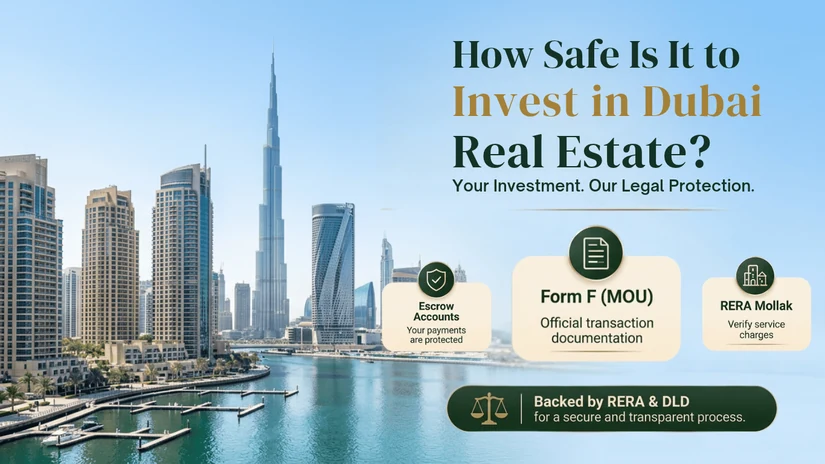
The emirate is also governed by a far-ranging legal regime administered by the Real Estate Regulatory Agency (RERA), the DLD enforcement arm.
When I studied the transactional dispute data published by the Dubai Land Department and reviewed by legal analyses in Gulf News on foreign buyer protections, I came to a clear conclusion that the safety of buying property in Dubai comes down to following the statutory safeguards already built into the legal system, which means the risks are minimal when you understand the government mechanisms protecting your capital.
Mandatory Escrow Accounts (Law No. 8 of 2007): Developers cannot utilise off-plan buyers’ installments until they have been paid into a project-specific escrow account for auditing by the DLD. Only then are funds released to the developer in stage payments (after the project is inspected by a government-engineering team).
When entering the secondary market, negotiations are rendered official on a standardised electronic form of Memorandum of Understanding (Form F), produced on the DLD portal, which captures buyer and seller terms and is supervised by escrow deposit cheques.
Building service charges are limited and verified via the RERA Mollak portal, thus ensuring building owners are unable to increase their maintenance costs arbitrarily.
How to Invest in Property in Dubai: The Standard Acquisition Process
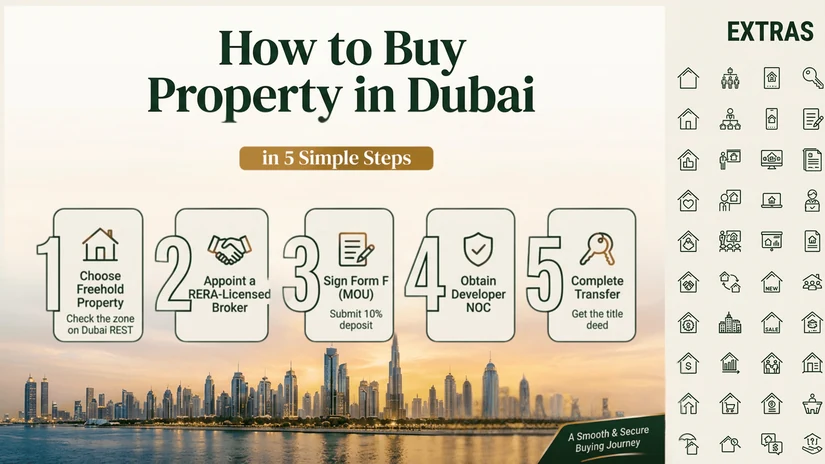
Your First Purchase: Your first purchase can be simple by using the statutory sequence:
Step 1: Choose Freehold Property & Check Zone on Dubai REST App
Step 2: Appoint a RERA-Licensed Broker
Step 3: File Unified Form F(MOU) & Submit the 10% Security Deposit
Step 4: Seller Secures Developer NOC (No Objection Certificate)
This is a critical rule when learning how to invest in property in Dubai is budgeting for all mandatory closing costs.
Register at the Trustee Office for the Transfer and Payment of the title deed.
This section should include budgeting for all mandatory closing costs. When purchasing a ready property, the buyer will need to budget for the 4% DLD transfer fee, the real estate trustee office fee (AED 4,000 + 5% VAT for transactions of AED 500k and above), agency fees (2% + VAT) and the developer NOC fee (from AED 500 to AED 5,000).
Avoid operational shocks by opting for reliable associates familiar with the rules of the local municipality. In the same fashion, an early check on the top interior designers in Dubai‘s credentials helps you get a feel for how much a spatial fit-out costs and how long statutory approval takes before finalising secondary acquisitions.
How to Invest in Dubai Real Estate with Little Money
Can expats buy property in Dubai on a small budget? You don’t even need millions of dirhams in liquidity to start creating exposure to the market. Here’s how to invest in Dubai real estate with little money.
1. Developer Off-Plan Payment Plans
Some developers provide post-handover instalment plans where the developer will make the remaining purchase price into relatively small instalments (eg., 1% monthly repayments over 3 to 7 years) after an initial 10-20% down payment. This puts you onto the asset ownership stage while allowing you to spread out capital commitments.
2. Fractional Property Investment Platforms
Financial technology reporting in The National highlights that property tokenisation and fractional ownership are rapidly gaining ground under Dubai Financial Services Authority (DFSA) pilot programmes.
Licensed platforms like Stake and SmartCrowd allow individual investors to buy shares in pre-vetted, income-generating rental properties for as little as AED 500 to AED 2,000. Investors receive automated monthly rental dividends directly into their digital wallets and participate proportionately in future capital gains. This is the most accessible way on how to invest in Dubai real estate with little money.
3 Non-Resident Mortgages
Although domestic residents can get up to 80% LTV on their primary residences, non-resident foreign investors can legally obtain financing by getting approved by one of the large banks in the UAE (Emirates NBD or FAB) for 50-60% of the value of the property.
Can expats buy property in Dubai as a rental investment? If you are an investor who owns an investment apartment for premium holiday rentals or executive corporate leasing, working with experienced interior designers in Dubai allows you to configure furniture plans that maximise smaller square footage, while knowing how to choose a luxury interior designer so you get robust commercial-grade furniture specifications for multiple tenants.
Common Property Acquisition Options: Quick Comparison
| Investment Path | Minimum Capital Required | Ownership Type | Residency Eligibility | Best Suited For |
|---|---|---|---|---|
| Direct Ready Property | AED 400,000 to AED 800,000+ | Freehold (Full Title Deed) | Yes (if property AED 750,000) | Immediate rental income & lifestyle |
| Off-Plan Phased Plan | 10% to 20% upfront deposit | Freehold (Oqood Pre-registration) | Yes (Golden Visa eligible if AED 2M) | Capital appreciation over construction |
| Fractional Real Estate | AED 500 (~$136 USD) | Digital Fractional Equity | No | Micro-investors seeking passive yield |
Actionable Rules Before Committing Capital
Always verify the Dubai REST plot: Do not take a brochure marketing a project as a “freehold”. Download DLD’s Dubai REST app and verify that the plot and the developer are registered in an approved zone.
Make sure all Cheques are in the Title Deed name: In the case of a secondary buy, never hand into the agent any manager’s cheques, other than depositing into an authorized brokerage’s trustee account. The 10% deposit must be in the Name of the Owner in the DLD Title Deed, which should never be handed over to the agent.
Check the previous service charges: Request the seller to provide you with the last 12 months of service charge receipts. A property that has a good selling price but with a service charge of AED 45 per square foot can significantly cut down your net rental yields.
In Conclusion: Can Expats Buy Property in Dubai?
So, can expats buy property in Dubai with complete legal peace of mind? Legislation says yes. With straightforward freehold ownership regulations regulated by DLD, enforced escrow protections on pre-construction projects and secure online title registration, Dubai is now among the easiest locations in the world for foreigners to buy property.
Can expats buy property in Dubai without surprises? All of this boils down to taking operational discipline with each of your transactions. Confirming plot zoning, understanding additional closing costs over and above the basic deposit, and having building service charges checked by the prescribed portals is how your capital is protected from signing to handover. When the time comes to handover, turn-key presentation, functional spatial flow, and top-notch finishes ensure long-term corporate tenants and healthy net yields.
Ready to Maximise the Value of Your Dubai Property?
Contact Our Team Today to set up your first meeting and make your property a profitable, beautiful home.
FAQs
Can expats buy property in Dubai under their personal name?
Yes, foreigners are allowed to own a property through their legal person’s name or by an acceptable corporate holding structure (JAFZA offshore company or DIFC foundation) in special freehold zones.
Are expats eligible for mortgage financing in Dubai?
Yes, expatriates, both resident and non-resident, can take out a mortgage with UAE banks. Residents usually make a 20% down payment (80% LTV), and non-resident buyers have to provide a cash down payment of 40-50%.
What happens to a freehold property if an expat leaves the UAE?
Nothing changes with your ownership. The freehold title deed registered with the Dubai Land Department is yours forever. You may lease out your unit to tenants, entrust property management to a qualified property management company, or sell remotely.
