
Table of Contents
- Why the Rent Figure Is Only Part of the Story
- Costs You Pay Before You Get the Keys
- Move-In Costs Most Tenants Forget
- The Cost of Making an Empty Flat Feel Like Home
- Ongoing Monthly Costs After You Move In
- Hidden Costs When Renewing or Moving Out
- How to Budget for the Hidden Costs of Renting in Dubai
- In Conclusion
- FAQs
Are you walking into a Dubai tenancy trap that could wipe out your emergency savings before you even unpack a box?
Through my work researching and analyzing the UAE property market for interior designs and property management projects, I constantly see newcomers being caught off guard when they discover the hidden costs of renting in Dubai, these
While I was reading tenant stories on Reddit and Expat forums, I found that hundreds of first-time tenants reported being charged 15,000 to 25,000 AED more on move-in week; they were also charged hidden fees by the landlord, and some tenants had to pay penalties to the authority.
Most of the charges are normal, but in my observation reviewing these property workflows no one makes that so clear before you agree to rent a property in Dubai.
In this guide, I will walk you through the true hidden cost of renting in Dubai. I will cover what you pay before getting the keys, the surprise move-in fees, the real cost of making a space liveable, and how to get your full deposit back when you leave.
Keep reading to see every fee so you can plan your budget with total peace of mind.
Why the Rent Figure Is Only Part of the Story
Property websites always show one big, clean number: the yearly rent. It makes apartments look affordable at first glance however, navigating the hidden costs of renting in Dubai begins with understanding how payments are actually structured.
Payment terms shape the hidden costs of renting in Dubai. In Dubai, rent is traditionally paid using post-dated bank cheques. Landlords usually ask for one, two, four, or six cheques across the year. If a landlord accepts four cheques, your first cheque covers three full months of rent on day one.
Ask the landlord how many cheques they require before you visit the property. If they want one or two cheques, negotiate for four cheques to protect your starting cash flow.
Costs You Pay Before You Get the Keys
Before you receive the keys to your front door, you have to pay several mandatory fees. These represent the primary hidden cost of renting property in Dubai during week one.
Security Deposit
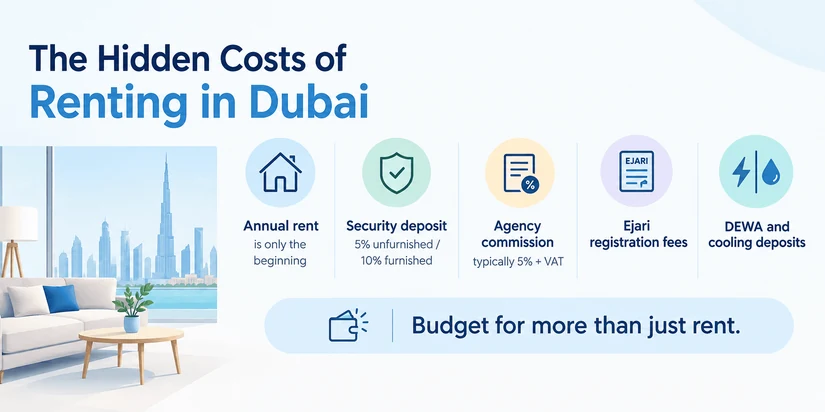
The deposit is the first of the hidden costs of renting in Dubai. Your landlord will collect a refundable security deposit to cover any damage, while you live there. For an unfurnished apartment, the standard deposit I see across contracts is 5% of the annual rent. For a furnished property, the deposit is 10% because the owner is protecting their furniture and appliances.
Real Estate Agency Commission
Agent fees add to the hidden costs of renting in Dubai. In Dubai, the tenant almost always pays the agent’s commission fee. The standard market rate is 5% of the first year’s annual rent. Do not forget that you must also pay 5% Value Added Tax (VAT) on top of that commission amount.
Ejari Registration
Ejari is the official tenancy registration system managed by the Dubai Land Department. By law, every lease in Dubai must be registered in this system. It costs around 175 to 220 AED, depending on whether you register online through the Dubai REST app or in person at a Real Estate Trustee center.
Checking That the Agent and Listing Are Real
Do not pay anyone unless you see their credentials; rogue operators still advertise fake listings online. Make sure your broker has an active broker card from the Real Estate Regulatory Agency (RERA). Also, check that the property advertisement has a verified Trakeess permit number.
Move-In Costs Most Tenants Forget
Once the contract is signed, you face a second wave of extra costs when renting in Dubai. These charges catch many first-time tenants off guard.
DEWA Connection Deposit and Activation
Utility deposits are among the hidden costs of renting in Dubai. To turn on your power and tap water, you must open an account with the Dubai Electricity and Water Authority (DEWA). DEWA charges a refundable security deposit of 2,000 AED for an apartment and 4,000 AED for a villa.
Chiller or District Cooling Deposit
In many modern Dubai buildings, air conditioning is supplied by district cooling providers like Empower or Tabreed rather than standard DEWA power. If your contract does not say chiller-free, you must open a separate cooling account.
Building Move-In Fees and Access Cards
Building fees also count as hidden costs of renting in Dubai. Most building management offices charge for tenant services. You will often need to pay between 100 AED and 250 AED for each security access card, gym tag, or parking gate remote.
Movers’ Access and Gate Approvals
You cannot just hire a moving van and pull up to the loading dock. Most master communities and towers require a formal Move-In Permit or No Objection Certificate (NOC) before letting movers past the security gate.
While reviewing legal precedents I went through the real-world tenancy case Harlow v Hattie 2017 DIFC SCT 105 heard at the Dubai International Financial Centre Small Claims Tribunal, an outgoing tenant faced moving chaos when building access issues and move approvals were not coordinated properly with building management.
If you do not submit your tenancy contract, Ejari, and mover trade license to building security at least 48 hours early, your movers will be turned away at the gate.
Internet and TV Setup
Setting up high-speed home internet with local providers typically requires an installation and activation fee of around 200 to 300 AED on your first monthly bill.
The Cost of Making an Empty Flat Feel Like Home
Most rental properties in Dubai are listed as unfurnished. For many newcomers, this is where the highest unexpected costs of renting an apartment in Dubai appear.
Furnishing is one of the biggest hidden costs of renting in Dubai. An unfurnished flat in Dubai is truly empty. In most cases, there are no ceiling lights, no kitchen appliances, no curtain rods, and no towel rails. It is just bare white walls and concrete floors.
Curtains and Blinds
Curtains aren’t just for decoration; they are a necessity due to the intense sunlight it receives throughout the year. Your bedroom will become hot quickly and wake you up at dawn if the windows are on the east or west of your home. Special blackout curtains or wide roller blinds for large sliding doors can range from 2,500 AED to 6,000 AED on average. Consulting with top interior designers in Dubai can help you specify thermal-backed motorised tracks and custom drapery that lower indoor cooling demand.
Light Fittings
When you collect your keys, look up at the ceiling. You will often see bare plastic wires hanging from small holes. You need to buy your own light fixtures, ceiling fans, or chandeliers for every room. Working alongside a top interior designer can make a dramatic difference here by mapping out layered ambient and task lighting with portable fixtures that avoid rewiring penalties later.
White Goods and “Semi-Furnished” Traps
Pay special attention to property descriptions and semi-furnished could be anything. It might be a complete set of kitchen equipment, or it could be an ancient microwave and a dirty stove.
If you rent an unfurnished apartment, you must keep a budget to buy:
- A refrigerator and freezer
- A washing machine
- A cooking range or built-in oven and gas hob
Smart Storage and Rental-Friendly Decor
If you drill deep holes into walls to hang heavy floating shelves, your landlord may charge you to plaster and repaint the entire room when you move out.
Try to invest in high-quality freestanding storage, modular wardrobes, and floor-standing book shelving. If you aren’t sure where to start with your aesthetics, learning how to choose an interior design style can help you narrow down the best modular pieces and colour palettes for your new space.
When to Bring in an Interior Designer
Knowing how to choose a luxury interior designer is the best way to ensure you partner with someone who understands high-end rental constraints. The best interior designer in Dubai can identify long-lasting furnishings that are perfect for your space, and create clever storage that won’t require any drilling and effectively mitigating another hidden costs of renting in Dubai.
Ongoing Monthly Costs After You Move In
Once you unpack and settle into your new home, your monthly financial commitments go beyond your basic rent cheques. Keep an eye out for these hidden costs of renting in Dubai.
Dubai Municipality Housing Fee
Many expats are surprised when their first DEWA bill arrives. Every expat tenant pays an official Dubai Municipality housing fee. This fee is calculated as exactly 5% of your annual rent, split into twelve equal monthly charge which is added directly to your water and power bill. If your annual rent is 96,000 AED, you will pay 400 AED every single month.
Summer Cooling Bills
Cooling bills are seasonal hidden costs of renting in Dubai. Air conditioning bills can change drastically across the seasons. In buildings with chiller-free air conditioning, the cooling power runs through your standard DEWA bill or is covered by the landlord.
In buildings connected to private district cooling, you pay a monthly capacity charge all year, plus a consumption charge. During July and August, when summer temperatures reach forty-five degrees Celsius, cooling bills can rise by several hundred dirhams per month.
Minor Maintenance Clauses
Repair clauses add to the hidden costs of renting in Dubai. Read your tenancy contract carefully. Most standard Dubai tenancy contracts state that the landlord pays for major structural repairs, while the tenant pays for minor maintenance.
Contracts usually set a threshold, such as 500 or 1,000 AED. This means that if a water heater valve leaks, an AC belt snaps, or a drain blocks, and the fix cost around 350 AED.
Parking Fees for a Second Vehicle
Most one-bedroom and two-bedroom apartments come with one free allocated parking space in the building basement. If your household has two cars, finding a spot for the second car can be difficult. Renting a second parking bay from the building management or another owner typically costs between 3,000 AED and 6,000 AED per year.
Hidden Costs When Renewing or Moving Out
When your lease finishes, leaving the property can cost money if you are not careful. Security deposit disputes are common throughout the city.
According to a Khaleej Times report from October 2026, the Dubai Rental Disputes Centre (RDC) had to interfere in 2,350 rental cases worth over AED 401 million in the first nine months of the year. Leaving a property without clear documentation can easily pull you into one of these disputes.
Ejari Renewal and Agency Renewal Fees
Renewal fees are hidden costs of renting in Dubai that come back every year. When you renew your lease for another year, you must register a new Ejari certificate. Some real estate agencies also try to charge an annual contract renewal fee of 1,000 AED to 1,500 AED just for printing the new contract pages. You can negotiate or reject this fee if the agent does not provide any active property management service.
Repainting and Nail-Hole Deductions
Repainting is one of the hidden costs of renting in Dubai that shows up at move-out. Many landlords expect the unit to look brand new when you return the keys. If you hung wall art, left raw screw anchors in the walls, or scuffed the skirting boards, landlords often try to deduct 1,500 AED to 3,000 AED from your deposit to repaint the entire apartment.
In a recent tribunal judgment, Nazeem v Niamat 2024 DIFC SCT 377, an owner deducted thousands of dirhams from a tenant’s security deposit for wall nail marks, unpainted patches, and cupboard damage.
The court had to inspect photographic evidence to decide what was fair wear and tear versus tenant damage which means if you leave deep holes or marks in the walls, the landlord has legal grounds to hold your money.
Deep Cleaning and Lost Access Cards
If you do not hire professional cleaners before your final checkout inspection, the landlord will likely hire a cleaning company and take the cost straight out of your deposit. Similarly, if you lose one of your building entry cards or parking gate remotes, the building management office will charge you up to 300 AED to replace it.
Final DEWA Clearance
When you leave, you must apply for a DEWA final disconnection. DEWA deducts your final utility consumption from your original 2,000 AED deposit and refunds the remaining balance to your bank account. Your landlord will demand to see this official DEWA Final Clearance Certificate before returning your rent security deposit.
Notice Periods and Early Cancellation
If your job relocates or you need to leave the country before your twelve-month lease ends, you cannot just hand over the keys and walk away. Standard leases state that if you break the contract early, you must give sixty days’ written notice and pay a penalty equal to one or two months of rent.
How to Budget for the Hidden Costs of Renting in Dubai
I have created this first-year planning table to help you track every expense category before you commit to a property:
| Before You Get the Keys | First Rent Cheque Installment | Property Landlord | Non-refundable |
| Before You Get the Keys | Tenancy Security Deposit | Property Landlord | Refundable at move-out |
| Before You Get the Keys | Real Estate Agency Commission + VAT | Real Estate Brokerage | Non-refundable |
| Before You Get the Keys | Ejari Tenancy Registration | Dubai Land Department / Trustee | Non-refundable |
| Move-In Week | Electricity & Water Security Deposit | DEWA | Refundable at move-out |
| Move-In Week | Utility Meter Activation Fee | DEWA | Non-refundable |
| Move-In Week | District Cooling Deposit & Setup | Empower, Tabreed, or Emicool | Deposit portion refundable |
| Move-In Week | Access Cards, Fobs & Lift Deposit | Building Management | Lift deposit refundable |
| Move-In Week | Moving Company & Packing Service | Licensed Moving Contractor | Non-refundable |
| Move-In Week | Home Internet & TV Activation | Telecom Provider (e& or du) | Non-refundable |
| Making the Flat Liveable | Blackout Curtains, Blinds & Rods | Window Treatment Supplier | Non-refundable (You keep items) |
| Making the Flat Liveable | Ceiling Light Fixtures & Handyman | Lighting Store & Technician | Non-refundable (You keep items) |
| Making the Flat Liveable | Kitchen White Goods & Appliances | Electronics Retailer | Non-refundable (You keep items) |
| Ongoing Monthly Costs | Dubai Municipality Housing Fee | Dubai Municipality (via DEWA) | Non-refundable |
| Ongoing Monthly Costs | Monthly Power, Water & Summer Cooling | DEWA & Chiller Provider | Non-refundable |
| Ongoing Monthly Costs | Minor Repairs Under Contract Threshold | Maintenance Contractor | Non-refundable |
| Ongoing Monthly Costs | Extra Basement Parking Bay Lease | Building Management / Resident | Non-refundable |
| Renewal or Move-Out | Annual Ejari Renewal Registration | Dubai Land Department / Trustee | Non-refundable |
| Renewal or Move-Out | Wall Patching, Repainting & Deep Clean | Maintenance & Cleaning Crew | Non-refundable |
| Renewal or Move-Out | Final Utility Disconnection Clearance | DEWA & Chiller Provider | Deducted from utility deposit |
In Conclusion
Understanding the hidden costs of renting in Dubai makes the difference between a stressful move and an exciting start in a new home. When you budget for your utility deposits, building permits, window treatments, and move-out requirements ahead of time, you keep full control of your finances.
If you have just collected the keys to an unfurnished space and want to transform it into a stylish, functional home without breaking building rules, contact us; we can help bring your vision to life with personalised layouts and rental-friendly styling.
FAQs
Who pays for Ejari, the tenant or the landlord?
In Dubai, the tenant is responsible for paying the Ejari registration fee when signing a new lease or renewing an existing one. Registering the contract through the Dubai REST app is the fastest and cheapest option. While a few corporate build-to-rent landlords occasionally waive or cover Ejari during promotional campaigns, private landlords almost always leave this cost to the tenant.
Is the DEWA deposit refundable?
Yes, your DEWA security deposit (2,000 AED for apartments and 4,000 AED for villas) is 100% refundable when you move out. When you apply for your final bill online, DEWA deducts your last few days of water and electricity consumption plus a small disconnection fee from the deposit, then transfers the remaining balance directly to your UAE bank account via IBAN.
What does chiller free mean in Dubai?
“Chiller free” means the landlord pays for the building’s central air conditioning cooling charges through their annual service fees, rather than passing bills on to you through a private district cooling company like Empower or Tabreed. In a chiller-free apartment, you only pay DEWA for the small amount of electricity needed to run the AC fan coils inside your flat.
Is it worth hiring an interior designer for a rented apartment?
Yes, especially if you are renting an unfurnished apartment or villa for two or more years, moving with family, or working from home. A designer saves you from expensive buying mistakes by sourcing modular furniture, freestanding storage, and custom window treatments that make the home look incredible without drilling into walls, protecting your security deposit and making it easy to move with you later.
